The Hanged Man Tarot Card Meaning
The Hanged Man General Meaning
The Hanged Man upright: Stop struggling and let this pause happen — surrender here isn't losing, it's how you see the angle you're currently missing.
The Hanged Man reversed: You're stalling out of fear and calling it patience, or sacrificing for a cause that doesn't need it. Stop performing the wait and actually decide.
The Hanged Man Love Meaning
The Hanged Man upright: Put your own agenda down for a moment and really see this from their side. The pause creates clarity here, not distance.
The Hanged Man reversed: You're staying in this dynamic out of a martyr complex, not genuine care. That's not the same thing — notice the difference.
The Hanged Man Career Meaning
The Hanged Man upright: Let this project or decision stay on hold a little longer — the delay is giving you a perspective you don't have yet.
The Hanged Man reversed: You're stalling this career move out of fear and dressing it up as patience. Name the fear and move anyway.
The Hanged Man Money Meaning
The Hanged Man upright: Hold off on this financial decision — the wait itself is doing real work, not wasting time.
The Hanged Man reversed: This money is sitting idle because you can't decide, and the indecision itself is costing you the opportunity. Choose.
The Hanged Man Health Meaning
The Hanged Man upright: Rest is the active treatment right now. Take the pause without guilt — it's doing the work.
The Hanged Man reversed: You're staying passive longer than this recovery actually needs. Time to move again.
The Hanged Man Decisions Meaning
The Hanged Man upright: Don't force this — let it sit until the new perspective actually arrives on its own.
The Hanged Man reversed: You're using 'waiting for clarity' as cover to avoid a decision that's already ready to be made. Make it.
Deeper Meaning
Symbolism
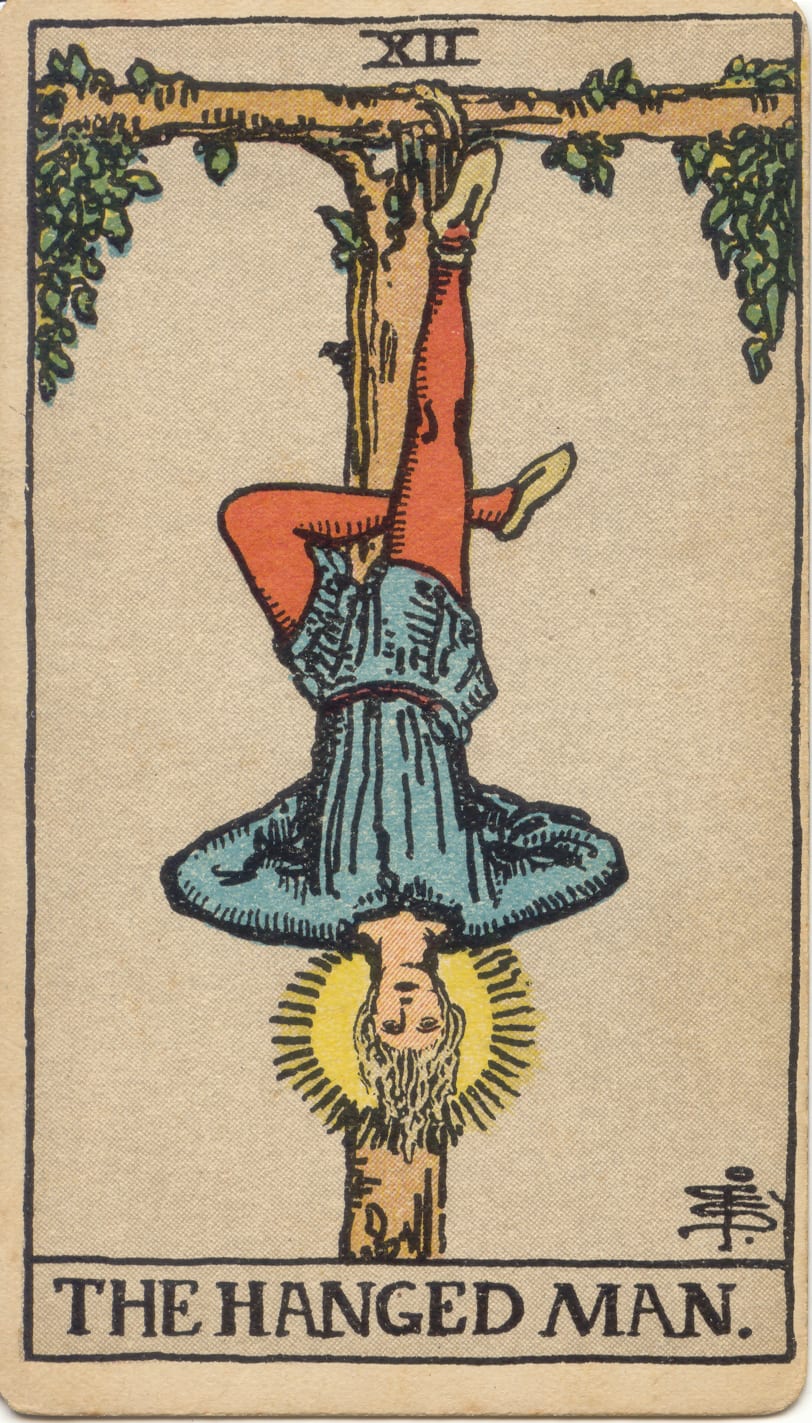
A young man hangs upside down by one foot from a T-shaped wooden gallows, his other leg bent to form a loose figure-four cross behind the straight one. Rather than distress, his expression is calm, almost serene — a halo-like glow surrounds his head, suggesting illumination gained specifically because of the inverted position rather than despite it. His hands are tucked behind his back, bound or simply at rest, and the tree he hangs from is living, budding at the ends — this suspension is not an execution but a passage.
Correspondences
Numbered 12, and often associated with the element Water in some esoteric systems, or with the planet Neptune in more modern correspondence sets — dissolution, surrender, altered perception. The Hebrew letter Mem (water) is traditionally linked here, reinforcing the association with the fluid, dissolving, non-linear nature of the state this card depicts.
Waite's Reading
Waite is unusually direct in rejecting the more sinister folk reading of this card as betrayal or punishment, insisting instead that it represents 'wisdom' attained through voluntary sacrifice and a complete reversal of ordinary perspective. He draws attention to the halo of light around the head as proof the card is fundamentally about illumination — the world looks different, and truer, once you've stopped struggling against the position you're in. For Waite this is one of the deck's most spiritually significant cards precisely because its surface imagery is so easily misread as purely negative.
Combinations
Beside Death, the pairing reinforces a reading toward necessary transformation through surrender rather than resistance. Near Four of Swords, both suggest rest and withdrawal are doing real, if invisible, work. Next to The Chariot, the contrast is instructive — active forward will against total voluntary stillness — worth noting which mode the reading is actually calling for.