Wheel of Fortune Tarot Card Meaning
Wheel of Fortune General Meaning
Wheel of Fortune upright: This is changing whether you steer it or not. Get ready to move with it instead of trying to hold the old shape in place.
Wheel of Fortune reversed: You're fighting a shift that's going to happen anyway. Stop resisting it and start adapting to it — that's the faster way through.
Wheel of Fortune Love Meaning
Wheel of Fortune upright: This relationship is entering a new phase, driven as much by circumstance as by either of you choosing it. Go with it.
Wheel of Fortune reversed: It feels like things keep happening to this relationship instead of within your control. Find the one thing you can actually decide, and decide it.
Wheel of Fortune Career Meaning
Wheel of Fortune upright: An opportunity is about to shift into view from outside your plan — stay ready to move on it rather than forcing your original plan through.
Wheel of Fortune reversed: This setback is timing, not a verdict on your performance. Don't overcorrect — it will turn again.
Wheel of Fortune Money Meaning
Wheel of Fortune upright: A turn for the better is coming from circumstance more than direct effort. Stay receptive to it rather than trying to force it faster.
Wheel of Fortune reversed: This downturn isn't on you. Ride it out instead of panicking into a decision you'll regret.
Wheel of Fortune Health Meaning
Wheel of Fortune upright: This is shifting in a way that's genuinely out of your hands right now. Let it turn rather than fighting the timeline.
Wheel of Fortune reversed: This keeps circling back because you're treating it as one-off bad luck instead of a pattern. Look for the actual cycle underneath it.
Wheel of Fortune Decisions Meaning
Wheel of Fortune upright: Part of this is outside your control. Decide based only on the part you can actually influence, and let the rest go.
Wheel of Fortune reversed: You're fighting circumstances that won't move. Adapt your plan to them instead of forcing the plan through anyway.
Deeper Meaning
Symbolism
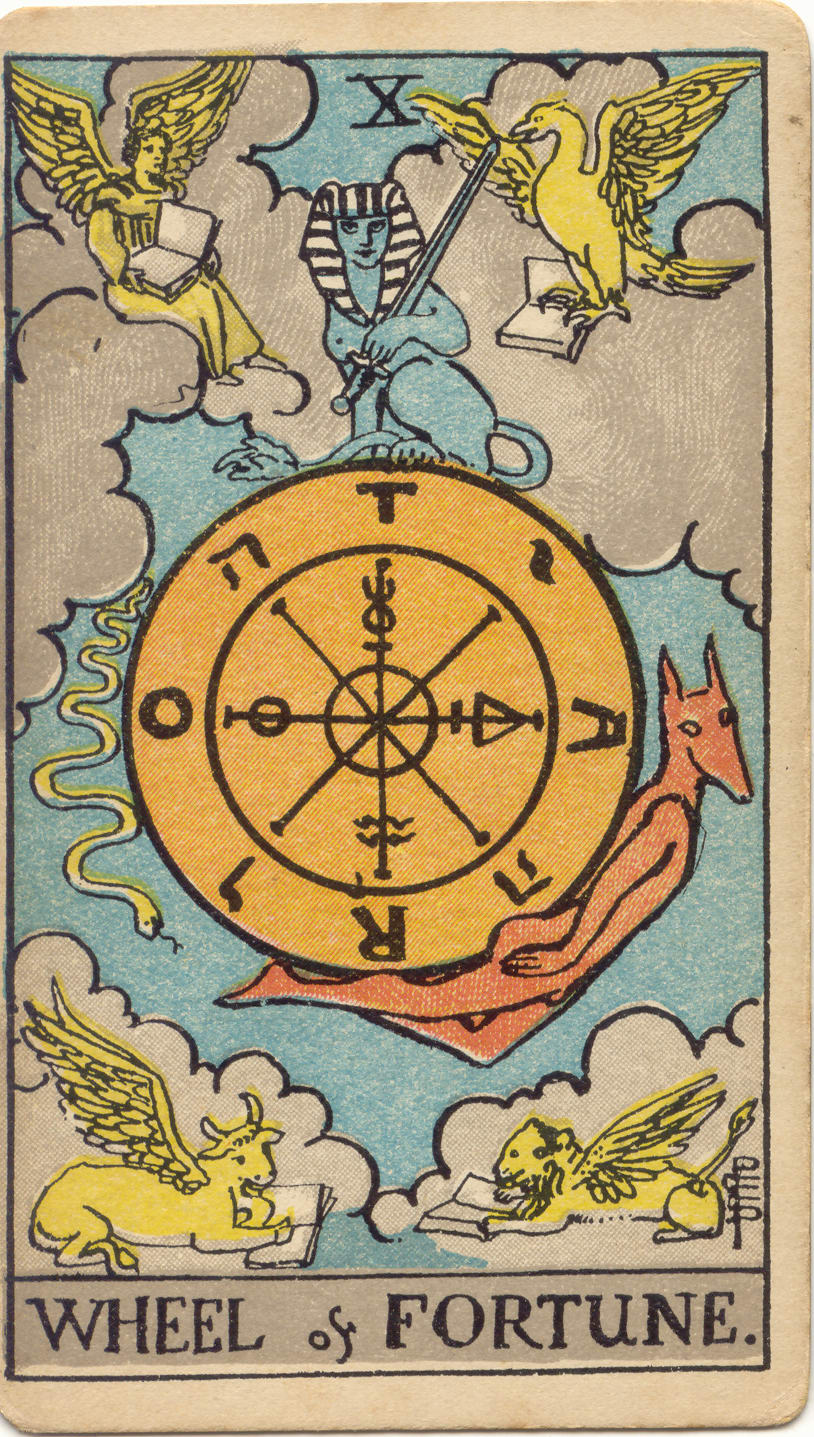
A wheel turns in open sky, ringed with alchemical and astrological symbols — mercury, sulfur, salt, and water alongside signs for the fixed elements. Four winged figures at the corners — a man, an eagle, a lion, and a bull, drawn from Ezekiel's vision and later tied to the four Evangelists — read steadily from open books, unmoved by the wheel's turning. A sphinx sits atop the wheel bearing a sword, representing the equilibrium or judgment that presides over change without being swept up in it. A serpent descends on one side, and a jackal-headed figure (Anubis-like) rises on the other, marking the wheel's two directions.
Correspondences
Numbered 10, marking the completion of the first full cycle of numbers and, fittingly, a card entirely about cycles. Associated with the planet Jupiter — expansion, luck, the larger movements of fortune beyond individual control. The Hebrew letter Kaph (palm of the hand, or a cupped container) is traditionally linked here, suggesting fortune as something held and then released again.
Waite's Reading
Waite emphasizes the four fixed, reading figures at the corners as the still point around which the wheel's constant motion happens — 'the perpetual motion of a fluidic universe' surrounding a stability that doesn't itself change. He reads the sphinx atop the wheel as equilibrium amid flux, and stresses that the card concerns forces largely outside personal control — the proper response, for Waite, is neither despair at a downturn nor complacency at an upturn, but recognition of the larger pattern turning beneath both.
Combinations
Beside The Star, a downturn implied by the Wheel is softened toward eventual renewal. Near The Tower, both cards concern disruption from outside forces — together they suggest change arriving suddenly and from beyond one's control, worth bracing for rather than resisting. Next to Ten of Swords or other 'rock bottom' cards, the Wheel offers real reassurance that the cycle will turn again.